

Protecting Geographical Indications for Spirits in Venezuela: Why One Legal Route Is Not Enough

A geographical indication for a spirit does more than identify a place. It connects a product to a defined origin, production standards, and a reputation built over time. Names such as Scotch Whisky, Cognac, and Tequila carry commercial value precisely because consumers associate them with those attributes.
Protecting that value in Venezuela requires a particular approach. Venezuelan domestic legislation does not provide a dedicated sui generis registration system for the recognition and management of foreign geographical indications. That gap complicates enforcement, but it does not leave rights holders without legal options.
The practical question is not simply, “How do we register the name?” It is: Which legal route addresses the specific misuse, and what evidence will make that route effective?
Start with the nature of the right
A geographical indication should not be treated as an ordinary trademark. A name that identifies a product’s geographical origin may face obstacles if a party attempts to register it as a conventional mark. Conversely, a third party’s trademark application may itself become a point of intervention if it appropriates or misleadingly incorporates a protected geographical indication.
This distinction matters because different acts call for different responses. A conflicting trademark application, a misleading label, an online listing, and a shipment at the border are not the same problem. A sound protection strategy must identify the conduct before choosing the remedy.
TRIPS provides the central legal framework
The Agreement on Trade-Related Aspects of Intellectual Property Rights (TRIPS) establishes the starting point. Article 22 addresses geographical indications generally. It requires legal means to prevent uses that mislead the public about a product’s geographical origin, as well as uses that constitute unfair competition under the Paris Convention.
Spirits also benefit from the additional protection in Article 23. Under that provision, a geographical indication identifying a spirit may be protected against use for a spirit that does not originate in the indicated place—even where the product’s true origin is stated, the indication is translated, or the name is accompanied by expressions such as “kind,” “type,” “style,” or “imitation.” Article 23 also addresses conflicting trademark registrations.
That difference is commercially significant. The issue is not limited to whether a consumer mistakes one bottle for another. A producer may invoke a protected origin while acknowledging that its own product comes from elsewhere.
In Venezuela, SAPI’s Official Notice No. DG-09-2020 provides a relevant basis for invoking TRIPS provisions directly where the conditions identified in that notice are met. It strengthens the case for a treaty-based argument; it should not, however, be described as an automatic enforcement mechanism. Rights holders still need to establish which provision applies, why it can be relied upon in the proceeding, and how the alleged conduct falls within it.
Match the response to the conduct
TRIPS is the foundation, not the entire strategy. Other rules may become decisive depending on how the geographical indication is being used.
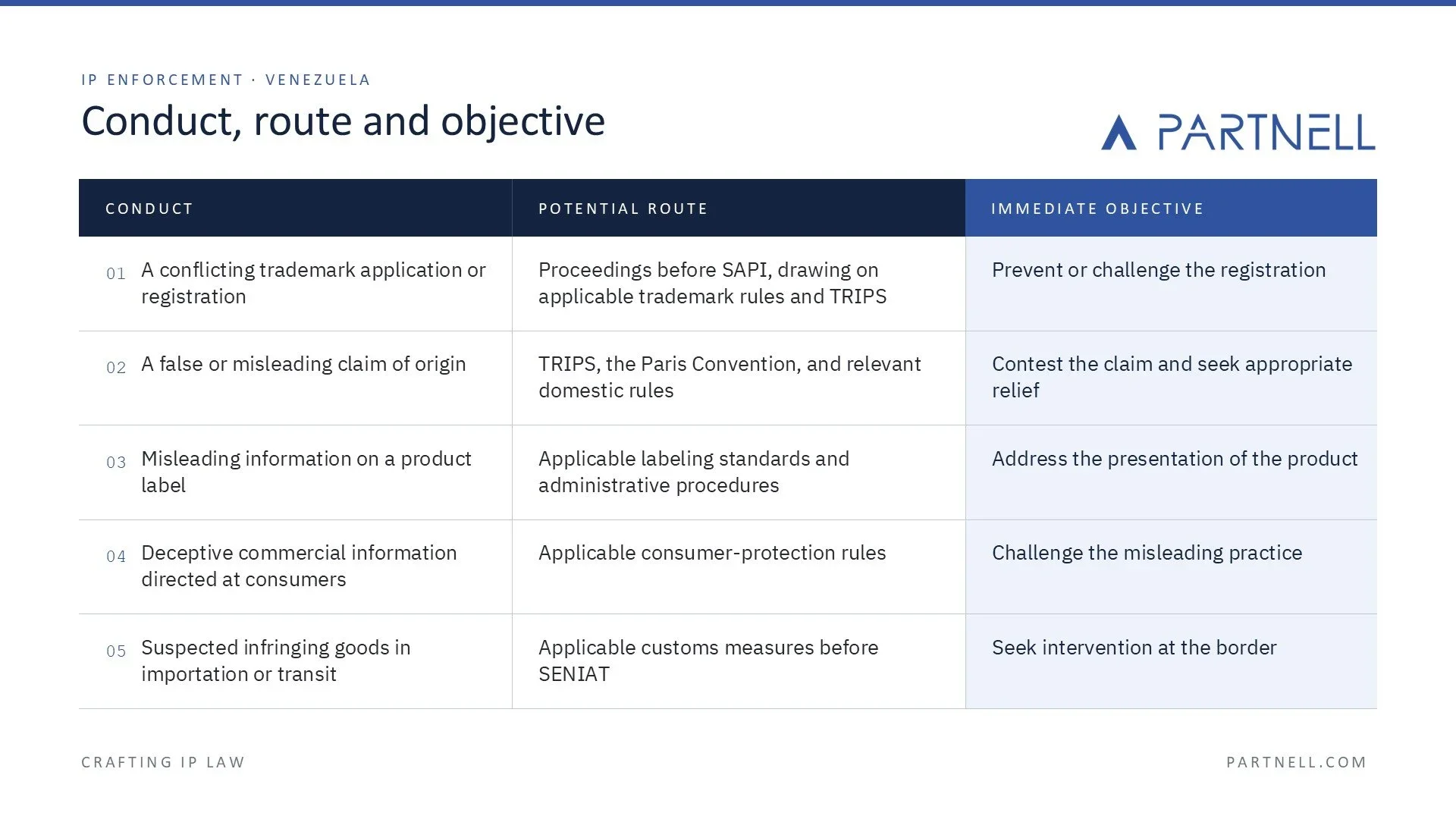
The Paris Convention is particularly relevant to false indications of source and unfair competition. Venezuelan industrial-property rules can provide further arguments against signs that falsely suggest origin or quality. Labeling and consumer-protection rules address another dimension of the same conduct: what the seller tells the market about the product it is offering. Customs measures may become relevant where the goods are entering or transiting the country.
These avenues should not be invoked indiscriminately. Their value lies in selecting the competent authority and appropriate remedy for the facts at hand.
Build the evidence before filing
Legal arguments cannot substitute for proof. A rights holder should be prepared to establish the status of the geographical indication, its connection to the place of origin, the conditions governing its use, and the nature of the challenged conduct.
A working evidence file should include:
Official documents establishing the geographical indication’s legal status in its place of origin.
The product specification or equivalent governing instrument.
A clear description of the protected geographical area.
Information about authorized producers and applicable control or certification systems.
Evidence of the indication’s reputation and, where available, its recognition in Venezuela.
Samples, labels, advertising, invoices, screenshots, or other records of the suspected misuse.
Spanish translations and any formalities required for the proceeding in which the documents will be used.
Preparation is not a procedural afterthought. It determines whether an international reputation can be translated into a persuasive claim before a Venezuelan authority.
Monitor the market, not just the register
Trademark surveillance remains important, but it is only one part of the task. Potential misuse may first appear on a label, in a retailer’s catalogue, on an e-commerce platform, or in an import shipment.
A monitoring program should therefore cover trademark publications, physical and online sales channels, advertising, and relevant import activity. When a questionable use appears, evidence should be preserved promptly and in a form suited to the contemplated action. Early detection preserves options; delay can narrow them.
Protect origin through a coordinated strategy
A geographical indication concentrates the value of origin, production discipline, and accumulated reputation. In Venezuela, protecting that value requires a coordinated assessment rather than reliance on a single filing or a single authority.
Protecting a spirit’s geographical indication in Venezuela is not a matter of invoking every available rule. It is a matter of identifying the misuse, assembling the evidence, and choosing the legal route capable of addressing it. Origin carries value only if its rightful holders can defend it where that value is put at risk.