

Intellectual Property in Venezuela: From Portfolio Maintenance to Portfolio Resilience

For many multinational companies, Venezuela has long been treated as a maintenance jurisdiction. The objective has often been limited: preserve registrations, renew key rights, and wait for more favorable commercial conditions.
That approach can be insufficient.
An intellectual property portfolio may appear active on paper while remaining exposed to operational failures that emerge only when the company needs to enforce a right, record a corporate change, move funds, oppose a third-party filing, or prove ownership before an authority. In Venezuela, those points of friction deserve attention before they become disputes.
The relevant question is no longer whether a portfolio remains registered. It is whether it is sufficiently documented, funded, monitored, and enforceable to support the company’s commercial position.
Political and compliance conditions are part of IP management
Intellectual property does not operate separately from the broader compliance environment. International sanctions, financial-institution review processes, payment restrictions, and internal corporate approval systems can affect the timing of routine IP actions.
This matters because procedural deadlines do not necessarily align with the time required to clear internal approvals or process cross-border payments. A renewal, recordal, opposition, appeal, or official-fee payment may become time-sensitive long before the legal department receives confirmation that funds are available locally.
For that reason, companies should identify critical deadlines in advance and coordinate legal, finance, and compliance teams accordingly. A practical approach may include an advance-funding protocol for material filings and renewals, calibrated to the company’s internal controls, the value of the asset, and the procedural timetable.
The point is not to overfund a portfolio. It is to prevent an avoidable administrative deadline from becoming a loss of rights.
A digital filing is not the same as a verified process
Digital tools can improve access to filings and administrative Information. They do not remove the need for local verification.
A filing may be submitted electronically, while its processing, examination, supporting documentation, fee assessment, or physical record remains subject to additional steps. In such settings, relying exclusively on a dashboard, a database extract, or an automated status update can create a false sense of certainty.
This is particularly relevant for multinationals that manage large portfolios through centralized global systems. Those systems are valuable, but their accuracy depends on the quality, completeness, and timing of local source data.
For Venezuelan portfolios, companies should consider a verification process that combines:
Digital monitoring of pending matters and published information.
Periodic confirmation of the procedural status of high-value applications and registrations.
Preservation of filing receipts, powers of attorney, official communications, payment records, and certified copies where appropriate.
Direct review of files when a case involves a dispute, a material deadline, a chain-of-title issue, or an unusual delay.
Technology supports portfolio management. It does not replace evidentiary control.
Portfolio records must survive corporate change
A trademark certificate is only as useful as the ownership record behind it.
Global mergers, acquisitions, internal restructurings, name changes, assignments, and changes in corporate domicile often create a gap between the entity that owns the right under global corporate records and the entity shown in the local register. That gap may remain unnoticed until the company needs to enforce the mark, oppose a conflicting application, record a license, or bring an action against an infringer.
The risk is not merely administrative. If the local chain of title is incomplete, the rights holder may face delays, objections, additional costs, or uncertainty about standing.
A portfolio audit should therefore confirm:
The registered owner of each material right.
The consistency between local records and the current corporate structure.
The status of unrecorded assignments, mergers, name changes, or other title events.
The availability of supporting corporate documents and powers of attorney.
The status of coexistence agreements, settlements, licenses, and other documents relevant to use or enforcement.
Local recordal should not be treated as a low-priority formality. It is part of the enforceability architecture of the portfolio.
Market control requires more than registration
In fragmented markets, a trademark often performs a function beyond source identification. It helps preserve consumer trust, differentiate authorized channels, and support action against confusing, misleading, or counterfeit goods.
That does not mean every parallel import is unlawful, nor that every commercial irregularity is a trademark matter. The legal analysis must distinguish among genuine goods, unauthorized distribution, counterfeits, misleading uses of signs, labeling issues, and unfair competitive conduct.
Still, registration provides the legal platform from which a company can assess and pursue available measures. Rights holders should maintain market intelligence that is proportionate to the value and exposure of their brands, including:
Monitoring potentially conflicting trademark applications.
Reviewing retail, digital, and distribution channels for suspected misuse.
Preserving evidence of relevant products, labels, offers, advertisements, and invoices.
Evaluating, case by case, whether trademark, consumer-protection, customs, contractual, or unfair-competition measures are available.
A registration is not the end of brand protection. It is the legal base from which protection can begin.
A practical resilience audit
The shift from passive maintenance to portfolio resilience begins with an audit. The goal is to identify which assets are commercially material, legally enforceable, procedurally current, and operationally ready.
A useful audit should ask:
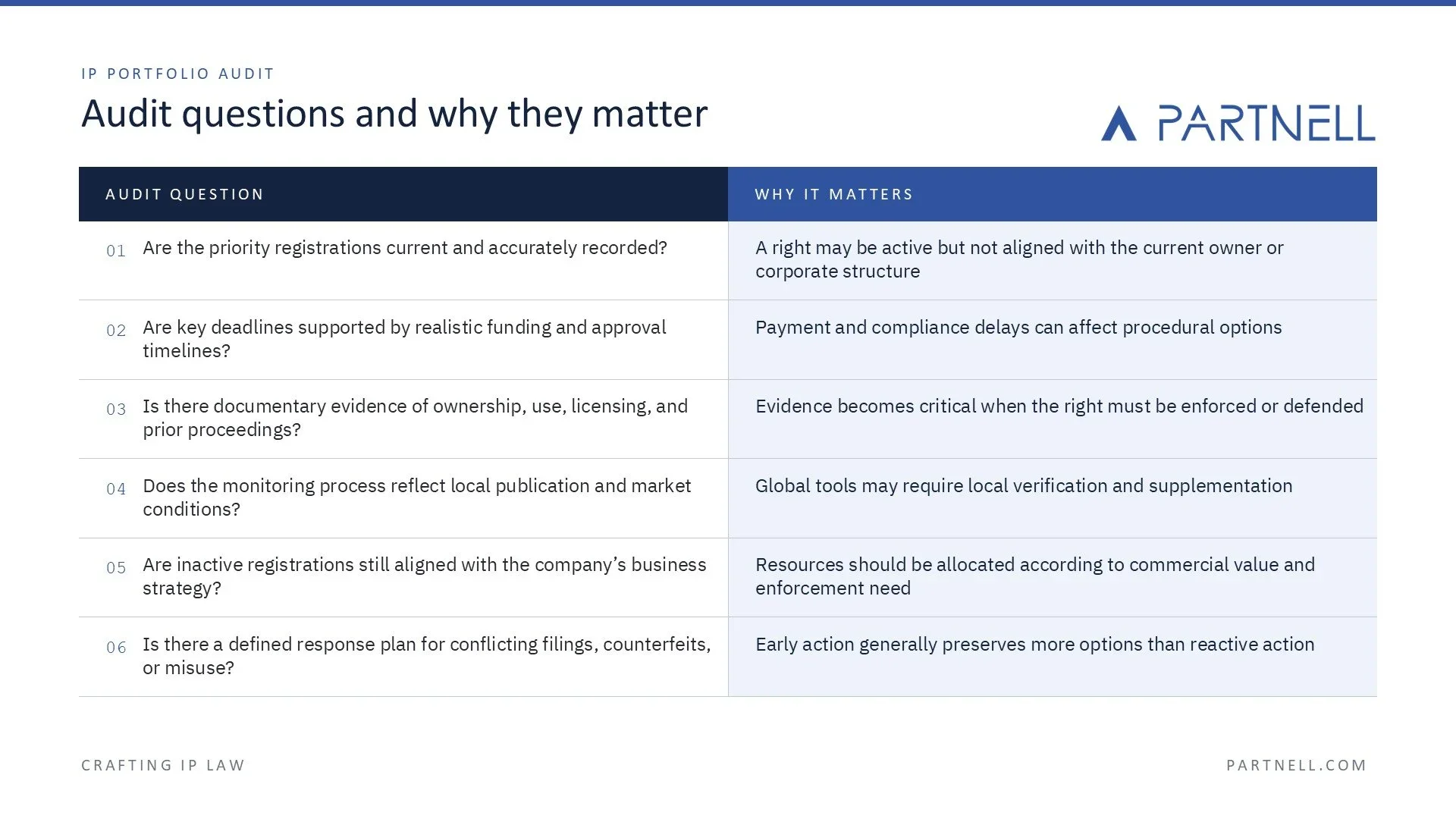
Not every registration merits the same level of investment. Some may have little commercial relevance; others may support market access, licensing, enforcement, or future expansion. The objective is not to preserve every asset at any cost. It is to understand the function of each asset before a deadline or dispute forces the decision.
The real measure of portfolio strength
A portfolio cannot be evaluated solely by the number of registrations it contains. Its strength lies in the connection between legal title, procedural readiness, commercial relevance, evidence, and local execution.
For companies with interests in Venezuela, the central task is to move from registration maintenance to asset resilience: verify ownership, prepare for deadlines, preserve documentation, monitor the market, and align the portfolio with the company’s actual commercial strategy.
A right that cannot be documented, funded, monitored, or enforced is not fully protected. It is merely recorded.